The Shocking Truth About How Toronto Travels

The Runway Paradox
When looking Toronto, Canada’s largest economic hub, we might assume the residents are constantly on the move. Many marketers picture urban professionals packing up for weekend trips to provincial parks, or enjoying a regional staycation. However, data from Manifold Data Mining Inc.’s latest Canadian Travel Patterns report suggests something entirely different.
Believe it or not, Torontonians actually travel less frequently than the average Ontarian in every quarter of the year. Instead of fighting bumper-to-bumper traffic on Highway 401, they save their disposable income for a different destination. While the rest of Ontario happily packs for their road trips, Toronto’s population prefers an actual runway. They choose to focus their time and money on major international travel instead.
Why Toronto Ignores the Local Highway
The data reveals a major difference in travel behaviour. Toronto CMA has far fewer domestic same-day trips compared to the rest of Ontario (Index 82). On the other hand, they rarely engage in same-day interprovincial travel (Index 27).
One likely explanation is the effort required to leave the city for a weekend gateway. For those in Toronto, leaving the city on Friday afternoon would cause more harm than relaxation. As a result, Toronto residents don’t desire road trips the way a lot of Canadians do.
However, when Toronto residents do travel within Ontario, they stick to popular leisure destinations. While the rest of Ontario enjoys spontaneous drives, Toronto appears to concentrate its domestic travel around well-known vacation spots. They significantly over-index for trips to York, Durham and Hills of Headwaters (Index 137), Niagara Falls and Wine Country (Index 120), Muskoka, Parry Sound and Algonquin Park (Index 117), and the Bruce Peninsula and Southern Georgian Bay (Index 111).
Overall, Toronto travelers spend 22% less on operating their own cars during day trips compared to the rest of Ontario.
This isn’t limited to one type of domestic travel. Toronto residents take fewer trips within Ontario across almost every category. They take fewer overnight domestic trips, fewer interprovincial overnight trips, and fewer repeated trips throughout the year.
Regional tourism boards frequently target downtown Toronto, but our data shows that these local marketing campaigns may not deliver the strongest return on investment.

The International Runway Shift
When Toronto residents finally decide to take a vacation, they choose to go all out. The Toronto CMA significantly over-indexes Ontario on international overnight trips (Index 118).
Toronto CMA Travel Index Highlights (Benchmark: Ontario)
- Domestic same-day Interprovincial Trips: Index 27
- Domestic Same-Day Trips: Index 82
- International Overnight Trips: Index 118
- Vehicle Operation Spending: Index 78
- Intercity Transportation Spending: Index 118
Instead of driving, Toronto residents choose a journey that begins at Pearson Airport. Toronto travellers over-index on intercity transportation spending (Index 118) and vehicle rentals (Index 109). They tend to choose long-haul flights over regional commutes.
Toronto residents are more likely to use commercial airlines as the primary means of travel (Index 107). They are also 33% more likely to return to Canada by air. Additionally, they heavily over-index for arrivals through Terminal 1 at Pearson (Index 143) and Terminal 3 (Index 150).
Cultural Ties Drive Global Flight Paths
The international travel preference is largely due to the demographic makeup of Toronto, which is Canada’s most diverse metropolis. Many residents travel internationally to visit loved ones abroad.
Our data shows a massive spike for specific international locations. Toronto residents are twice as likely to visit China (Index 200) and India (Index 200) compared to the baseline set by Ontario. Polaris’ Demographics Ethnicity Report helps explains this trend. For example, individuals of Chinese descent make up 10.26% of the Toronto CMA population compared to just 5.69% of Ontario residents. Similarly, East Indian origins account for 9.09% of Toronto’s population, which is almost double the Ontario baseline of 5.4%.
Toronto also over-indexes on travel to Jamaica (Index 146) and many European hubs. Individuals of Jamaican origin account for 2.18% of the Toronto population, and only 1.39% of the Ontario population.
This highlights the massive role of Visiting Friends and Relatives (VFR) tourism. In a city where nearly half of the population was born in another country, vacations often involve visiting relatives, attending weddings, celebrating holidays, or reconnecting with extended family.
The Financial Fuel Behind the Jet-Set Lifestyle
Going on international trips while the rest of the province settles on road trips isn’t just about preference. It demands significant financial capital. Manifold’s latest income data shows that consumers in the Toronto CMA have the necessary resources to choose airport over highway.
The average household income in Toronto is currently $143,509, while the provincial average is $129,908. This income gap gives Toronto households greater flexibility when planning international travel. They make around 10% more than the provincial average, which means they can more easily absorb higher travel costs. A luxury international trip package fits comfortably in their budget.
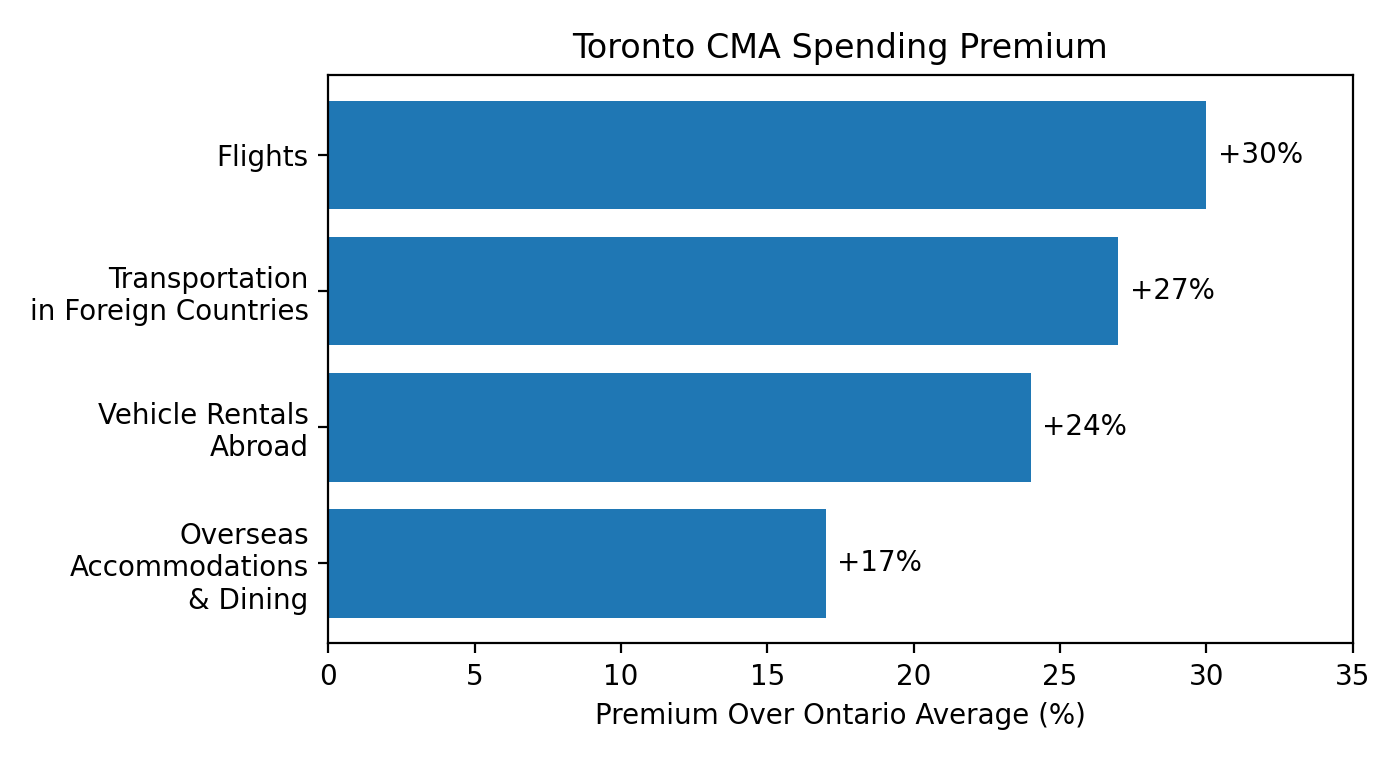
The contrast between Toronto and all of Ontario highlights why broad marketing strategies often fall short. Two consumers living only a few kilometers apart can have completely different travel preferences. Understanding these differences allows marketers to get the most out of their marketing budget.
Actionable Intelligence for Smart Brands
Domestic tourism operators should reconsider how their marketing budgets are allocated. Provincial parks, cottage rentals, camps, festivals, and other Ontario destinations often focus on downtown Toronto because of its large population.
However, Toronto residents are less likely to respond to campaigns promoting these domestic trips. If these advertisements were instead focused on more suburban communities, they would likely see greater return.
The opposite is true for businesses in international travel. This includes airlines, travel agencies, travel credit cards, travel insurance, luggage retailers, and even currency exchange services. These businesses can reach consumers who not only travel internationally, but spend more on their vacations in general.
The broader lesson extends beyond the travel industry. Population size alone cannot predict consumer behaviour. Companies can use data to gain a competitive advantage. Businesses need to understand how people actually live, allocate, and spend their disposable income before investing in marketing campaigns.
With Polaris Intelligence, organizations can combine travel, income, and demographic data. Businesses can identify high-potential markets instead of relying on assumptions. They can make data-driven decisions that improve their campaign performance.
 Powered by