How to Profit From Ontario’s Student Chaos
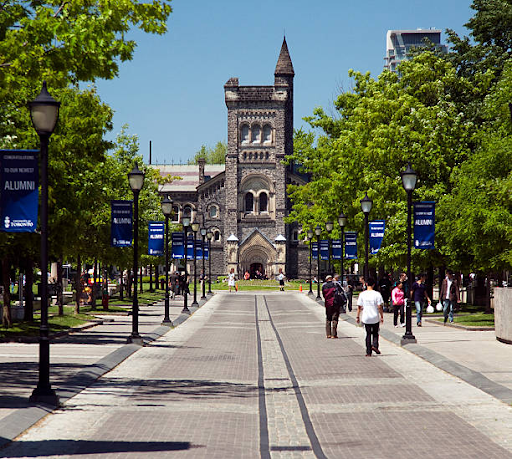
Every September, Ontario’s student cities undergo a major demographic shift. Tens of thousands of students enter these communities and create a unique consumer market across the province. However, not every university city attracts the same student population, nor offers the same opportunities for businesses.
This blog post analyzes the following four major areas: Toronto, Ottawa, Waterloo, and Kingston. Each city has distinct characteristics that influence student choices, lifestyles, and behaviours. Aside from academic programs, students sometimes choose their universities based on these varying lifestyles. Many individuals prioritize campus culture and social environments when choosing universities, while others choose based on commuting convenience.
These differences influence where individuals spend their time, money, and what services they rely on. By analyzing demographic and behavioural data, businesses can better understand the changing needs of Ontario’s student communities and identify emerging opportunities.
Understanding Ontario’s Student Markets
Ontario’s student cities play a significant role in shaping local consumer markets. However, each of these areas operates differently depending on the type of institution, housing, and the surrounding economy.
For example, some areas are primarily made up of students. In other cities, even though there are tens of thousands of students, they only make up a small portion of the population. This distinction changes how students operate as consumers, especially in housing, transportation costs, and daily spending patterns.
In larger urban markets like Toronto, students are only a fraction of the massive population. Their spending overlaps with long-term residents and commuting professionals. On the other hand, university-focused areas like Kingston or Waterloo tend to have a much more concentrated student population. This creates an economy heavily influenced by students.
Student behaviour largely relies on whether they live in student housing or if they commute. Those living on their own spend far more on groceries, restaurants, and basic services. Additionally, they spend more on university-related services and the businesses on campus. On the other hand, commuters tend to spend far more on transportation.
By comparing these student cities across the province, it becomes clear that location plays a major role in shaping student consumer behaviour. Understanding these distinctions helps explain how student demand translates into consumer activity.
Ontario Student Cities Compared
Waterloo (University of Waterloo, Wilfrid Laurier University)
Waterloo is one of Ontario’s most student-focused cities. Not only does it have two major universities, but it also has nearby colleges. The student population is highly concentrated.
In fact, 18.54% of Waterloo’s population falls within the 15–24 age bracket (28,631 people). 16.25% of the population (21,920 people) have attended university in the last three years, with 5.22% (7,043 people) currently enrolled full-time. Community colleges also represent a significant share of the local post-secondary population, with 6.21% of residents attending.
This concentration creates a strong student-driven economy. The local businesses depend heavily on student spending throughout the school year. Additionally, co-op programs contribute to a population that constantly moves between student life and early career experiences.
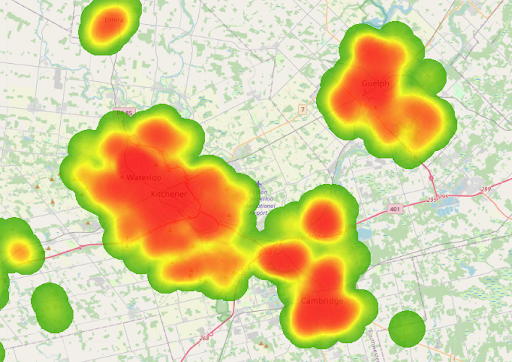
University student concentration across Waterloo CSD. A striking, high-intensity red “bullseye” forms directly over the major university campuses, visually proving Waterloo’s status as a dense, self-contained, and highly predictable student-driven economy.
Kingston (Queen’s University, St. Lawrence College)
Kingston has a traditional university-town structure. Queen’s University shapes the local economy greatly. Compared to larger cities, students make up a larger percentage of the local population.
While its 15–24 youth demographic sits at 13.77% (20,869 people), 10.31% of the population (13,594 people) have attended university within the past three years. Currently, 3.55% (4,686 people) are actively enrolled full-time, while community colleges account for 5.65% of the local market.
This suggests that the consumer market is strongly influenced by student lifestyle patterns. The restaurants, bars, and local services depend heavily on the academic calendar and the student presence.
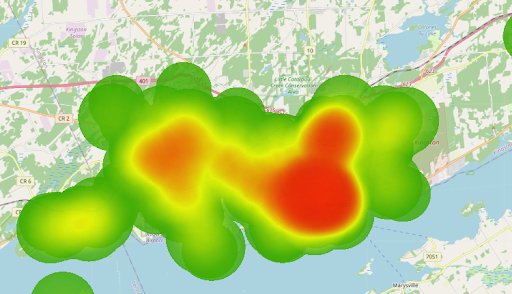
University student concentration across Kingston CSD. The data shows a stark, hyper-focused pocket of high concentration isolated strictly against the waterfront (the campus/student housing district), transitioning instantly into a traditional residential town structure.
Ottawa (University of Ottawa, Carleton University, Algonquin College)
Ottawa has a unique student environment due to its presence of multiple post-secondary institutions. It is also Canada’s capital and a major government employment center.
The city has a sizable youth market with 13.87% of the population aged 15–24 (168,172 people). University attendance over the past three years captures 11.95% of the city (123,226 people), while 4.86% (50,178 people) are currently full-time university students. Ottawa’s mixed market is heavily shaped by college attendance, which sits at 5.43% (56,023 people).
As a result, the student population resides alongside a large public sector workforce. This creates a mixed consumer environment where student spending overlaps with government professionals, and long-term residents. The consumer base in Ottawa is therefore more complicated compared to the smaller university towns.
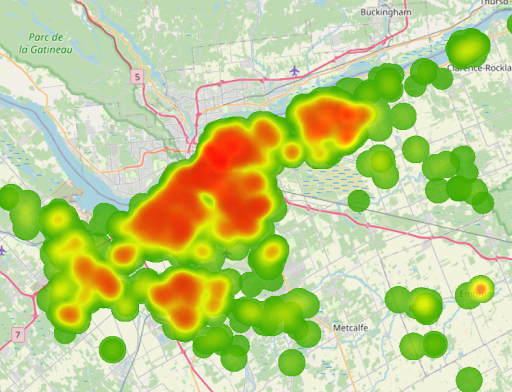
University student concentration across Ottawa CSD. The heat map shows distinct, localized institutional “islands” of student activity operating independently within a broader, blue-and-green landscape dominated by the public sector and government workforce.
Toronto (UofT, TMU, York U, OCAD)
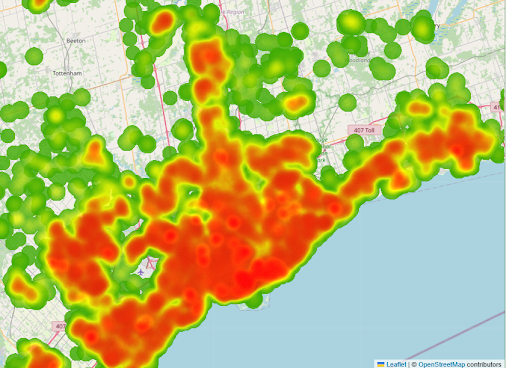
Toronto represents a different kind of city. It has multiple major universities and many colleges. This contributes to a large, distributed student population.
Nearly 1 million Toronto residents (943,518 people) have attended university within the past three years, representing 14.72% of the population. Currently, 4.89% (313,296 people) are enrolled full-time. The broader 15–24 youth demographic makes up 13.25% (989,695 people), while college attendees account for 5.24% (336,137 people).
However, students exist within a very large urban economy. Their spending overlaps with professionals, commuters, long-term residents, and local families. The student segment is highly diverse, but far less concentrated than smaller university cities
How Student Behaviour Differs Across Ontario
The city, housing type, and surrounding economies change student behaviour immensely. These populations share similar life stages, but their spending patterns differ based on the local conditions.
The biggest difference is daily spending. In concentrated student cities like Waterloo and Kingston, spending usually centers around the campus. Restaurants, entertainment, and essential services located near student benefit from higher student demand.
In contrast, students in Toronto have more diverse spending habits. Their spending often includes public transportation, retail, dining, and entertainment. They are usually more spread out, and don’t necessarily do the majority of their spending on campus. They share their space with the non-student population, so their behaviour is less concentrated in specific zones around campus.
Ottawa has a hybrid case. Students often split spending between campus areas and broader services. Due to the government workers, the pricing, availability, and consumption patterns in the city vary.
The data highlights these structural differences clearly. Waterloo leads the pack in pure density with over 18% of its population in the youth bracket, validating its status as a highly concentrated student economy. Meanwhile, Toronto leads in market size, holding a massive pool of nearly one million recent university attendees despite being highly distributed.
Another key difference is transportation. Those residing near campus rely less on public transportation to get to school. They do, however, commute long-distance to go back home. In contrast, students in Toronto and Ottawa are more likely to live at home (away from school). So, they use public transportation far more regularly.
Overall, student behaviour is not uniform across Ontario. It is shaped by the structure of each city. Understanding these differences is essential for identifying how student demand translates into consumer activity.
Why Student Cities Matter for Businesses
Understanding student behaviour across Ontario’s cities is essential for identifying consumer demand. Waterloo and Kingston have highly concentrated post-secondary populations, and have more defined spending patterns. Ottawa has a mixed environment where student behaviour overlaps with government workers and professionals. In Toronto, there is a highly diverse urban market where young consumer activity is distributed across a large economy.
These differences are important for businesses targeting a younger demographic. Marketing strategies that work in a concentrated university town may be far less effective in large urban environments. Similarly, product demand depends on whether individuals live on campus or commute.
By using demographic and behavioural data, businesses can identify where post-secondary populations are most concentrated and how spending behaviour differs. This allows for more precise targeting and a better understanding of demand.
Ultimately, Ontario’s university cities demonstrate that this is not a single market. It is a collection of distinct groups shaped by geography, housing, and local economic conditions.
This is where Manifold’s Polaris data provides valuable insights. By combining demographic and behavioural insights, it allows businesses to move beyond broad assumptions, and better understand consumer demand at a local level. Instead of treating all post-secondary areas the same, organizations can identify where specific consumer behaviours are concentrated.
In a market where location and life stages drive spending, this level of detail transforms general insights into actionable strategies.
 Powered by